
How to Log In and Manage Social Trading
The Social Trading interface allows you to monitor all subscribed strategies and manage your copy trading activities. You can also subscribe to additional strategy providers directly from your portfolio page.
Step 1: Log in to the Client Portal
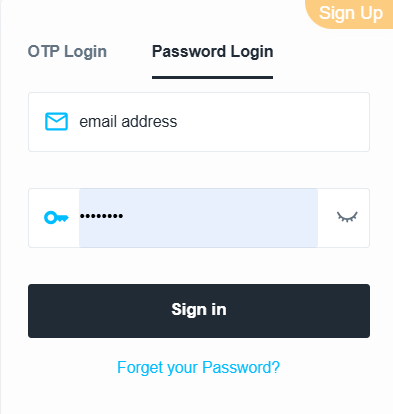
Please access the Client Portal and log in using one of the following methods:
- Your verified mobile number and one-time verification code
- Your registered email address and password
Step 2: Access the Socail Trading Interface

- In the left-hand menu, select Socail Trading.
- On the right-hand page, click Login to Social Trading.

- Select the server.
- Enter your trading account number and password (same as your trading platform credentials), then click Login.
Step 3: View Your Portfolio
Navigate to the My Portfolio menu to see your copy trading activity as a follower:
- Account Activity: Displays all active and inactive subscriptions.
- Profit/Loss: Shows monthly and previous month P&L.
- Performance Fees: Displays fees accrued during the current and previous months. For details, refer to your trading history. Note: Performance fees are only charged on profits generated during the subscription period.
- Top Performing Subscribers: Ranks subscribers by cumulative profits.
- Strategy Providers: Lists all subscribed strategy providers.
Click on any strategy provider’s username or the arrow next to it to access detailed portfolio information.
Step 4: Subscribe to Additional Strategy Providers
- On the My Portfolio page, click the blue Create button on the right.
- Select the trading account you want to use.
- Choose the strategy provider to subscribe to.
- Select a subscription plan.
- Confirm by checking I accept the Terms of Service.
- Click Create to finalize your subscription.
Step 5: Navigate Copy Trading Settings
The copy trading interface is organized into four main sections: Filter Settings, Subscription Strategy, Correction, and Risk Management.
A. Filter Settings
Adjust trade filtering rules to control which trades are copied. Click Edit to modify.
- Direction
- Options: All, Buy, Sell
- Choose whether to copy all trades, only buy trades, or only sell trades.
- Minimum Lots
- Trades below this volume will not be copied.
- Example: If set to 0.1 lots, trades smaller than 0.1 lots will be skipped.
- Maximum Lots
- Trades equal to or above this volume will not be copied.
- Example: If set to 5 lots, trades ≥ 5 lots will be skipped.
B. Subscription Strategy
Defines how trades from the provider are copied to your account. Click Edit to adjust.
- Trade Volume Scaling
- Options: Autoscale, Multiply, Fixed
- Autoscale: Adjusts trade volume according to the account balance ratio.
- Example: Provider balance $10,000, your balance $1,000, provider trades 1 lot → copied trade = 0.1 lot.
- Multiply: Scales trades by a set multiplier.
- Example: Provider trades 1 lot, multiplier 3 → copied trade = 3 lots.
- Fixed: Copies trades using a fixed volume.
- Example: Fixed 2 lots → every copied trade = 2 lots.
- Comparison Value: Use Balance or Equity for autoscaling reference.
- Multiplier: Determines the scaling ratio for copied trades.
- Copy Direction: Normal (same direction) or Reverse (opposite direction).
- Small Trade Handling: Skip Small Trades or Round to Minimum Lot.
C. Correction
Final adjustments to copy trades. Click Edit.
- Maximum Open Volume: Limits the size of each copied trade. Trades exceeding this volume will be adjusted.
D. Risk Management
Set acceptable risk parameters for your copy trading account. Click Edit.
- Parameters: Total Loss, Total Profit, Floating Loss
- Thresholds: Trigger actions when limits are reached.
- Subscription Action: Retain, Suspend, or Unsubscribe when thresholds are met.
- Trade Action: Retain All, Close All Orders, Close Losing Orders, or Close All Losing Orders.
E. Subscription Management
Manage your subscriptions directly from My Portfolio:
- Unsubscribe:
- Close: Existing positions are automatically closed.
- Retain: Keep existing positions under manual control.
- Suspend: Stop copying new trades while allowing existing trades to continue.